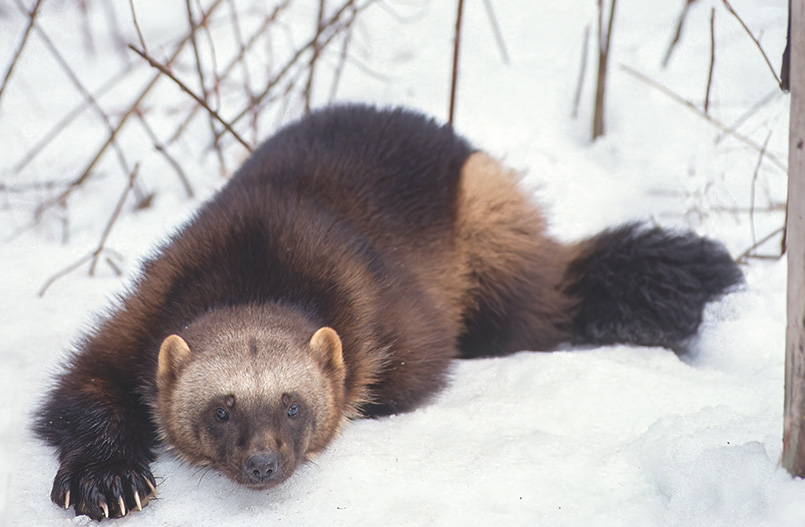
The fisher, once all but extinct in the Adirondacks, has now firmly re-established itself here.
According to John Davis, an Essex County writer and activist affiliated with the New Mexico-based Rewilding Institute, the fisher is “a rewilding success story.”
“The Adirondack Park is in many ways a wilder place today than it was a century ago,” Davis said at the Adirondack Research Consortium’s annual conference, held in Lake Placid this past April. “Species that were extirpated, or nearly so, are now thriving, including the fisher and the moose.”
Animal species are repopulating the region not simply because hundreds of thousands of acres have been added to the Adirondack Forest Preserve, or because the APA has slowed the disruption and fragmentation of the six-million-acre Adirondack Park.
They’re also returning as a consequence of programs connecting the wild landscapes of New England, the Adirondacks and Canada through so-called ecological corridors.
“Fishers not only like mature forests; they need habitat connections. They wander widely, covering more than a hundred miles within a relatively short period of time,” said Davis. “They are among the beneficiaries of our wildlife habitat connection efforts.”
Slowly – not surely, but possibly, and hopefully – a decades-old vision of connected, ecological corridors easing the passage of wildlife across the northern forest is coming to pass.
Over the Years, Wildlife Corridors Gained Support
Apparently, the concept of wildlife connectivity was first advanced by the conservation organization Wildlands Network in the 1990s, gaining acceptance as more scientists and resource managers came to recognize the effects of habitat fragmentation – a result of roads, suburban expansion and other forms of development – on wildlife.
Wildlands Network, of which Davis was a co-founder, proposed linking large core wilderness areas through protected corridors in order to create a continent-wide conservation framework.
Wildlands Network and other conservation groups emphasized that connectivity did not require creating continuous wilderness. Rather, corridors were likely to require partnerships among public agencies, private landowners, conservation organizations and local communities, working together to identify and protect key migration routes and natural areas.
For example, a group of local environmental protection organizations just recently urged the Adirondack Park Agency and the Department of Environmental Conservation to identify and protect the most remote areas of the Adirondacks. Protecting remote areas from any type of disturbance or intrusion – from snowmobiles to the ambient noise of distant traffic – eases the ability of wildlife to move freely across intact landscapes, the groups stated.
Climate Change and Ecological Corridors
John Davis argues that the need for connectivity “for many wide- ranging species has become especially important in this period of rapid climate change, as species shift their ranges in response to changing temperatures.”
Moreover, connected habitats improve biodiversity and increase the resilience of ecosystems facing environmental stressors, as a 2023 study published in the journal Science demonstrated.
In recent years, the wildlife connectivity concept has influenced numerous conservation projects across North America, including those in the Lake George area.
The Lake George Land Conservancy’s northeastern shore preserves, which comprise roughly two thousand acres of interlocking wetlands, woods and mountains, help connect the Green Mountains of Vermont with the Adirondack Park, Davis said.
Those preserves have also been identified by The Nature Conservancy as places supremely well situated to help nature thrive in the face of climate change.
According to the Nature Conservancy, which has awarded the Lake George Land Conservancy multiple grants to enlarge those preserves as recently as this year, plants and animals are moving at least 11 miles north and 36 feet higher in elevation every decade in response to the changing climate.
Waterways and Connectivity
Riparian lands, such as those bordering Lake George, lying within the Adirondack Forest Preserve or protected by the Lake George Land Conservancy, are especially important to the movement of wildlife, Davis said.
“One of the best things we can do in our region for wildlife is protect or restore forested shorelines,” said Davis. “That’s not only for the benefit of birds and aquatic wildlife; it’s vitally important for a range of terrestrial wildlife.”
Right-Sizing Culverts Helps
Many northeastern states and provinces have begun identifying critical migration routes and habitat connections as part of land-use planning efforts.
Mandates to right-size the culverts that lie underneath roads and highways so they can withstand the extreme weather associated with climate change presents new opportunities for strengthening connectivity, Davis said.
“Climate chaos is forcing us to improve our infrastructure; while we’re doing it, why don’t we make it wildlife-friendly, widening it so that fish and amphibians can go up and downstream, but allowing the larger critters to use it as well?” asked Davis. “Infrastructure can help restore wildlife connections.”