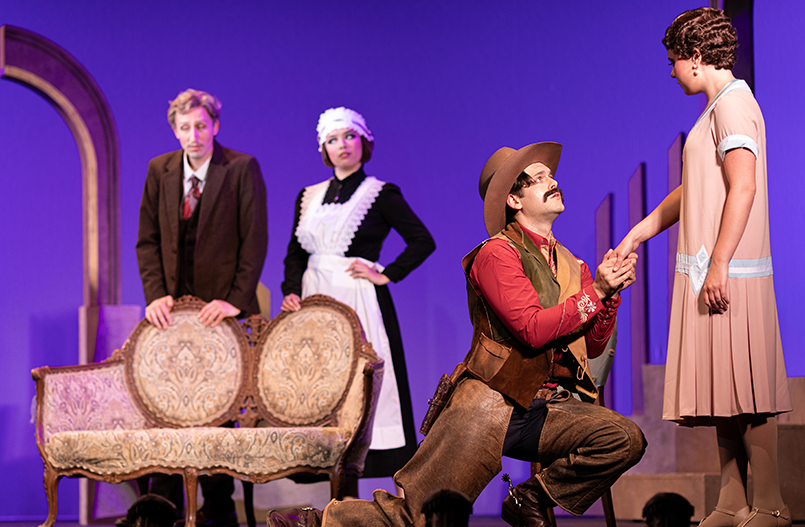
In 1805, Lorenzo Da Ponte arrived in New York City with little more in his luggage than a copy of Machiavelli’s play “Mandragola,” one of the primary sources of his libretto for “Cosi fan tutti,” which he wrote for Mozart 15 years earlier.
In both the play and the opera, reason in its many forms is assumed to be the enemy of love, except, that is, when it is used to defraud or deceive the beloved.
“Così fan tutte, or The School For Lovers” is traditionally viewed as just a silly story, full of disguises, deceptions, false fronts and trapdoors, one that just happens to be set to a ravishing score.
That view, however, is too narrow to encompass the issues at play in “Cosi” and willfully ignores the opera’s place at the intersection of the Enlightenment and the Age of Romanticism, of reason and eros.
The Seagle Festival’s production of “Cosi fan tutti,” running through July 25, is an invitation to reconsider these perspectives.
A surface is not necessarily superficial; it is what presents itself to us first; it is a come-on.
The Seagle’s version of “Cosi,” directed by Cara Consilvio and conducted by Filippo Ciabatti does justice to that glittering, giddy façade.
As Darren Woods, the Seagle’s Artistic Director, says, “Cara has done a brilliant job – telling the story in a way that I have not seen before. Nothing about the music has been changed, and yet everything sounds and feels fresh.”
Indeed, as conducted by Filippo Ciabatti, the score’s symphonic qualities are fully on display.
“Così fan tutte” follows two young officers, Ferrando and Guglielmo, who accept the wager of “the old philosopher” Don Alfonso that their fiancées will not remain faithful. Disguised as exotic strangers, they court each other’s beloved after pretending to leave for war. With the maid Despina’s unwitting help, the women gradually yield, revealing the fragility of their bonds. Eros, not reason, drives the main characters’ actions and responses.
The principal cast that we saw perform “Cosi” this week featured soprano Cristina Rosherger as Fiordilgi, mezzo-soprano Kayleigh Tolley as Dorabella, tenor Joshua Jones as Ferrando and baritone John Drake as Guglielmo.
It is frequently said that “Cosi” remains one of the greatest tests of emerging singers. It demands effortless vocal agility, stylistic elegance and believable comic acting in equal measure.
As Darren Woods said, “the cast rose to the occasion,” meeting the opera’s challenges with confidence, musical intelligence and remarkable dramatic commitment.
Woods said one of the perplexities of the opera is Don Alfonso’s motive – “what would make him think that making fools of women would be a fun thing to do?”
I suggested that “the old philosopher” is a stand in for Machiavelli himself, who, after all, is famous for asserting, “They will always be false to you unless they are compelled to be true by necessity.”
And what are we to make of the hymn to reason at the opera’s end? Gorgeous as it is, it seems a peculiar choice, given that reason has been shown to be an unreliable pilot through love’s rough waters. Or perhaps Mozart would have us believe that love has reasons of its own, and is, therefore, a kind of reason, or is reason-like. To be able to acknowledge or recognize love is a kind of knowledge, and, perhaps, the beginning of self-knowledge.
As Christopher Marlowe has his “Machiavell” say in the prologue to “The Jew of Malta,” “I hold there is no sin but ignorance.”
The Seagle Festival will present “Cosi fan tutti” on July 23 and July 25 at 7:30 pm and on July 24 at 2 pm. For tickets and information, visit seaglefestival.org. or call the box office at 518-532-7875.