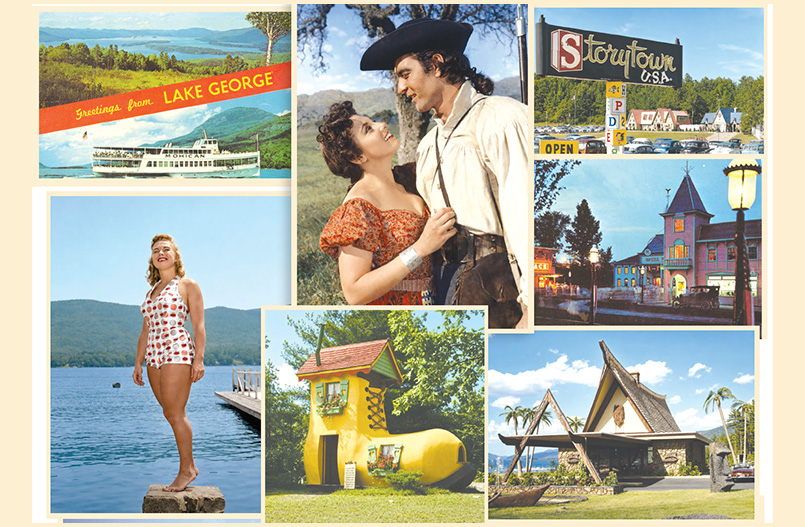
Recalling his first glimpse of Lake George in the 1920s, the artist Rockwell Kent wrote:
We’d crossed the all but endless flat plain north of Saratoga and passed through Glens Falls. Mountains? Still far away, you’d guess. Just rolling farmland backed by wooded hills. Yet we were climbing, had been for some time, and as we climbed, the woods came near; they flanked the road and shut us in; they choked the view. Then, suddenly, as we swept around a turn, the woods upon our right and dead ahead were gone. The land dropped deeply down. ‘God, look at that!’ we cried, swerved to the side, and stopped. It was Lake George. It was much more than that. Lake George, bordered by mountains, blue on that summer afternoon as lapis lazuli, lay like a carpet to the promised land whose canopy – had we until that moment even seen the sky that day? – was the whole cloudless dome of the heavens, purple at its zenith and gold behind the far-off mountains to the north. The Promised Land.”
The view of “the promised land” that captivated Kent became iconic, one treasured by the millions of people who drove to Lake George before the Adirondack Northway was built.
“When people came to Lake George in the 1950s and saw that view, I’m convinced they decided they had to move here,” Lake George’s town historian, Margy Mannix, told an audience assembled for the Bolton Museum’s first “Thursday Nights at the Museum” talk of the season on July 2.
Titled “Roadside Attractions,” Mannix’s presentation was a panoramic overview of Lake George tourism, from George Washington, James Fenimore Cooper and Thomas Cole to the last decades of the 20th century, when many mid-century attractions had closed or were about to. It complemented, and supplemented, the Bolton Museum’s current exhibit, “Welcome to Lake George: Vacation Paradise of the 50s and 60s.”
As Margy Mannix noted, from roughly 1848 until the opening of the Northway, the road from Glens Falls was the main approach to Lake George.
(The alternative, of course, was to come by train. Delaware & Hudson Railroad completed its line from Fort Edward to Lake George in 1882, allowing passengers to travel to Lake George from Saratoga, Albany and New York City. The last scheduled passenger train arrived at the Lake George station in November, 1957. The view that entranced so many travelers was the creation, in large part, of the railroad, The risk of forest fires from sparks thrown by railroad trains required the company to keep its right-of-way clear of trees.)
If the view did not induce everyone to move to Lake George, it certainly may have encouraged them to stay an extra two weeks.
By 1950, the transformation of Lake George’s tourist economy from a summer-long resort for the wealthy to a place where middle class and working families could come by car for a two-week vacation was all but complete.
But once these families were here, what were they to do? One answer: roadside attractions, specifically, small-scale, family-owned theme parks.
By 1957, the Adirondacks contained the greatest concentration of roadside attractions to be found anywhere in the U.S.
“North, south, east and west, the visitor industry is awakening to the fact that ‘attractions make business for all,’ lengthening the seasons and supplementing the vacation appeal of lakes, rivers and mountains,” reported the Lake George Mirror.
In 1967, Adirondack attractions collectively spent more than $1 million in new displays, rides and parking facilities and nearly $35,000 in print and radio advertising.
These investments were a response to the increase in tourism, and they stimulated more tourism as well.
At the prompting of Robert Moses, the father of Long Island’s Jones Beach, New York built the so-called Million Dollar Beach at the head of the lake; it opened in 1951. That same year, the Ticonderoga, a World War II naval vessel converted to an excursion boat by Wilbur Dow’s Lake George Steamboat Company, began daily dining and entertainment cruises down the lake.
The reconstruction of Fort William Henry began in 1953. Charley Wood opened Storytown, U.S.A. in 1954. A few years after Storytown opened, Wood added a new themed area to the park: Ghost Town.
Construction of the replica of Fort William Henry began on April 20, 1953. The museum’s doors opened to tourists thirteen months later and was completed in autumn, 1955.
By 1959, more people were paying admission to Million Dollar Beach than at any time since it had opened. That same year, to give the growing crowds (especially the adults) something to do in the evenings, Charley Wood opened Gaslight Village. Wood invested $100,000 – roughly $1 million in 2025 dollars – to build the attraction’s Fun Midway and Ferris Wheel.
Other local attractions included Animal Land, Indian Village and Magic Forest.
“We all had our niches; everyone offered a different experience,” Jack Gillette, whose father, Arthur Gillette, opened Magic Forest in 1963 as “Christmas City USA, featuring a Santa’s Village,” told the Lake George Mirror.
Magic Forest also came to incorporate Indian Village, a former Lake George attraction that opened in 1952 and closed after a 1958 fire.
Like the Frost family, which created the original Indian Village on Bloody Pond Road, the Gillettes invited Native Americans from western states to create an encampment that people could visit, watch ritual dances and ceremonies and listen to Native Americans discuss their history and lives.
In 1955, the Frosts opened a souvenir shop called the Indian Trading Post on Route Nine, and the Trading Post’s Teepee became a popular roadside attraction on its own. But according to Sam Frost, owners of attractions on Route 66 told him that the approaching interstate would divert most of his traffic, and he began looking for a shop in Lake George Village, which his son Doug now owns and operates.
The Northway reached Lake George in 1963, by-passing the roadside motels, gas stations, souvenir shops and theme parks.
Laura Rice, the curator at Adirondack Experience (formerly the Adirondack Museum) told the Lake George Mirror recently, “roadside attractions are now recognized as integral to the development of the Adirondack Park as a resort area in the 1950s.”
Museums, she said, “may have been slow to recognize the significance of these pieces of popular culture. Museums are often a generation behind. But we now have enough distance to place theme parks and the other attractions in the proper perspective.” The theme parks occupy a prominent place in “Welcome to Lake George: Vacation Paradise of the 1950s and 60s.” So, too, do dude ranches, water skiing and the transformation of Bolton Landing after World War II, which are also subjects of “Thursday Nights at the Museum” presentations. Visit theboltonmuseum.org. for dates and times. Located at 4924 Lakeshore Drive, with an entrance in Rogers Park, the museum is open 7 days a week, 10 am to 4 pm.