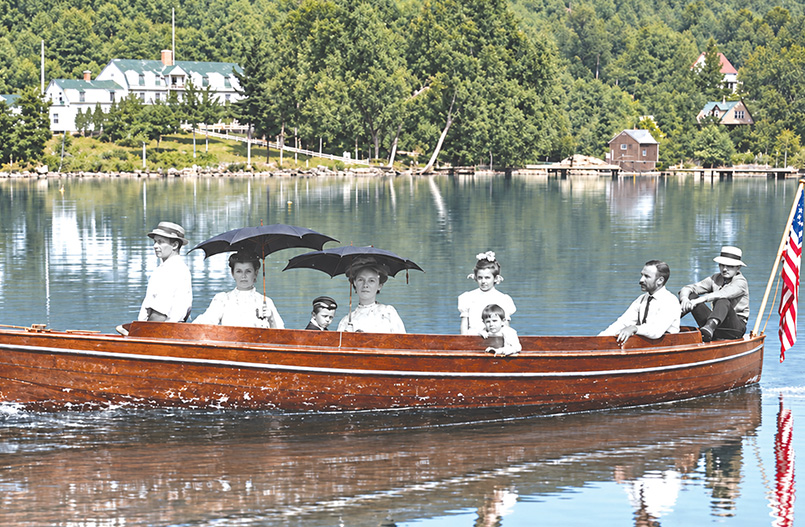
Born in 1839 on Friends Point in Hague, Wildman Hall Sexton was one of the finest boat builders on Lake George.
According to Dorothy Backus Offensend, his great-grand daughter, Sexton’s row boats were “comparable to a Lake George guide boat or skiff.”
Like the Lake George “guide boat or skiff” of F. R. Smith, Sexton’s boats were 16′ in length and featured the same distinctive wineglass stern.
Unlike F.R. Smith’s boats, which are smooth-skinned, Sexton’s boats were of lapstrake construction. They resembled Whitehalls, the antecedent of most of the rowboats native to Lake George.
Whitehalls, according to Adirondack boating historian Hallie Bond “emerged as a distinct type in the 1830s for use as a ferry boat and tender in the harbors of New York and Boston… they were soon in wide use as pleasure boats. They handled well in the choppy water sometimes found on large lakes.”
By 1889, Whitehalls were common on Lake George.
According to Reuben Smith, the wood boat restorer and organizer of Bolton Landing’s No-Octane Regattas, those who vacationed on Lake George were probably accustomed to seeing Whitehalls and expected their rowboats to resemble them.
In time, these boats evolved to suit the needs of Lake George. Unlike an Adirondack guide-boat, a Lake George boat needn’t be light enough to be portaged from one lake to another. If anything, it had to be more stable and sit higher in the water than a guide-boat to suit the larger lake and rougher waters. On the other hand, no one on Lake George was rowing through ocean swells, as a Whitehall might be required to do. Lake George demanded a boat with a freeboard high enough to protect a rower from a lake’s big waves, but not so high that it couldn’t be rowed comfortably. And since Lake George needed a leisure craft rather than a work boat, speed and ease of rowing were pre-requisites. Those could be accommodated by a stream-lined design.
Like Fred Smith, Sexton supplied boats to liveries and hotels, which needed stable, seaworthy boats for their guests. Many were inexperienced boaters and required boats that could be used without the assistance of a guide.
Among the hotels supplied by Sexton was the Uncas (now the site of the Northern Lake George Resort), which was owned by his nephew, Smith Sexton.
The Hotel Uncas also had its own launches, too. These, the Uncas and the Mohawk, could be chartered for excursions from the hotel’s docks. They were built by Wildman Sexton’s son, Jesse.
After Wildman’s death in 1903, Jesse took over the boatbuilding business, expanding it to include canoes and naptha and gasoline launches, as well as steamboats and rowboats.
Dorothy Backus Offensend writes, “Jesse died in December, 1927 in Hague. After his death, his tools and patterns for boats were taken by a cousin to sell. Neither the tools or the money was ever seen again.” Boats similar in design and construction to the Sextons’ rowboats can be seen at this year’s No-Octane Regatta, to be held September 26 from 9 am to 4 pm in Rogers Park in Bolton Landing.