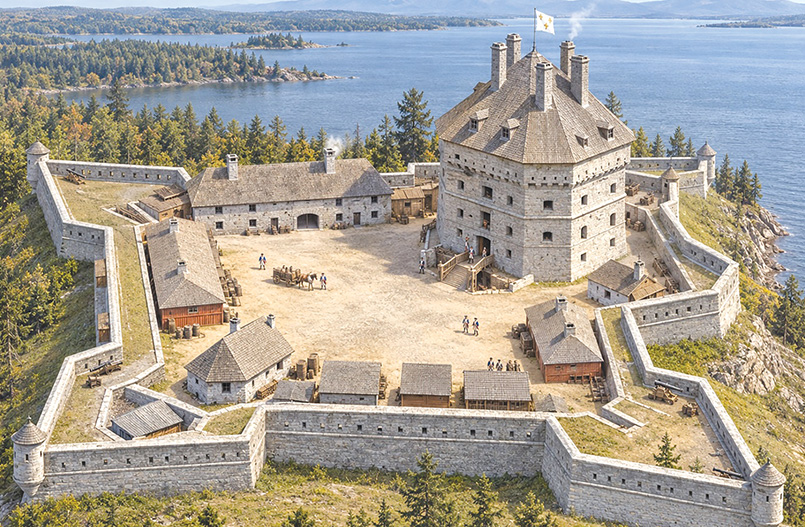
Of the many distinguished Europeans who visited Lake George and Lake Champlain, the least often mentioned, and yet certainly one of the greatest, was the botanist Peter Kalm, a member of the Swedish Royal Academy who traveled through the region in 1749.
Kalm was a student of Carl Linnaeus, whose greatest contribution to science was the concept of species and genera and other categories. The collection of 400 American plants that Kalm carried with him on his return to Sweden were listed and classified by Linnaeus with due credit to Kalm. Even before Kalm returned to Sweden, Linnaeus had honored his young disciple by designating the American mountain laurel “Kalmia latifolia.”
Peter Kalm was 33 when he visited northern New York in1749. While he considered his prime interest to be the collection and classification of plant species, his journals include observations of geography, topography, North American history, mineral and ore deposits, geology, architecture, animal husbandry and agriculture as practiced by the colonists, the wages of workers and the “short, coarse skirt” worn by the women of Canada “which does not reach the middle of their legs.”
His travels through the region started by boat from New York, bound for Albany, in early June. For the Albany Dutch, he had no kind words. The Treaty of Aix la Chappelle had just been signed by Britain and France, bringing to an end King George’s War which from 1740 to 1748 had embroiled English and French colonists and their Indian allies. The inhabitants of Albany had remained neutral during that war, Kalm said, and had continued to trade with the Indians whom the French has assigned to ravish northern New York.
The destination of Kalm and his party was Montreal, with most of the trip made by water, with Fort St. Frederic, or Crown Point, the first French port of call. He wrote that they were forced to use “a canoe” because they could get neither bateaux nor boats of bark. His definition of the boats is confusing. He describes a canoe as a single piece of wood hollowed out, which we call a dugout. His “bark boat” sounds like the birch bark canoe except that it is made of elm bark. His description of the bateaux, however, conforms to what we know about the craft famous for its role in the work and wars on Lake George – some 18 feet long with a flat bottom and usually pointed at both ends.
At what is now Hudson Falls, the party abandoned their craft and hiked through the woods to Fort Anne, which was in ruins, having been burnt by the British in 1713 when a plan to invade Canada misfired. Launching another boat on Wood Creek, they headed for Lake Champlain. On July 2, they were received at Crown Point. Kalm noted that it was not only a military garrison, but a thriving community of more than 1,200 souls who shipped supplies back and forth to Canada aboard sloops constructed at their own shipyards.
With its stone windmill for grinding wheat into flour, churches, paved streets, crude dwelling houses, gardens, ox carts, and the peculiar dress of its people, the village might as well have been transported from medieval France.
Were Fort St. Frederic attacked, the settlers would, presumably, be able to take refuge in the fort, which was constructed with a moat, drawbridge and iron portcullis, resembling a French castle more than the stockaded fortresses common in the New World.
Every family had been granted a plot for a garden, and contemporary observers believe that a number of foreign species now growing in our region escaped form the gardens and orchards of the French settlers, including asparagus, a member of the orchid family, roses and thorn apple. Kalm mentions none of these, but described other plants, such as burdock, milkweed, a kind of parsley called chervil and dandelion, all of which have edible parts.
According to historians, it is not clear how actively the government of France promoted settlement in the Champlain Valley. If it showed any interest in the colony at all, it may have been for “the glory and profit for its leaders,” in this case, the Governor General of Canada, the Marquis de la Gallissonniere, who was interested in using soldiers and settlers to collect information about the New Word’s natural history.
As a result, “there are few places in the world where such good regulations are made for the advancement of natural sciences” as Fort St. Frederic, Peter Kalm wrote.
Fort St. Frederic was destroyed by the French as they retreated toward Canada in 1759.
As the British advanced, the settlers dispersed. According to the 1938 proceedings of the Vermont Historical Society, the final entry in the parish register, the burial of an infant in July, 1759, “marks the tragic passing of the settlement.”
The proceedings continue, “American historians of the 19th century were not only able to study the mute evidence of abandoned homes… but to consult survivors, who held in memory the life of the settlements and the struggle that ended their existence.”
After visiting Canada, Kalm returned to the American Colonies by way of the Richelieu River and Lake Champlain. On October 21, he entered Lake George, then known by its French name, Lac du St. Sacrement.
Kalm’s notes may be considered base-line data for every study of Lake George’s plant life since then.
“In some places are found pines, firs and arbor vitae. The birch is also found now and then,” he writes. Chestnut trees grow along the shore; they were prevalent on Lake George until the 1920s, when a blight destroyed them. Kalm also mentions a lichen that Native Americans eat to sustain themselves when threatened with starvation.
Of this portion of the trip, a recent biographer of Kalm, Paula Ivaska Robbins, writes, “The area was a no-man’s land, without settlements. Even the Indians came only occasionally to hunt. During their journey through this wilderness, the guides told stories around the campfire at night of the atrocities committed during King George’s War, including the scalping of captives while they were still alive. Kalm must have been frightened by these tales, for he wrote, ‘The long autumn nights are rather terrifying in these vast wildernesses. May God be with us!’”
Kalm returned to Scandinavia, and civilization, in 1751, and assumed the role of a successful 18th century academic, writing, teaching and lecturing. hand, seem to confirm it.) According to Russell Bellico, the author of numerous books about the Lake George and Lake Champlain regions in the 18th century, Kalm’s greatest claim to fame now lies in the fact that “he was the first competent scientist to study colonial America extensively and publish the results.” He died in 1779.