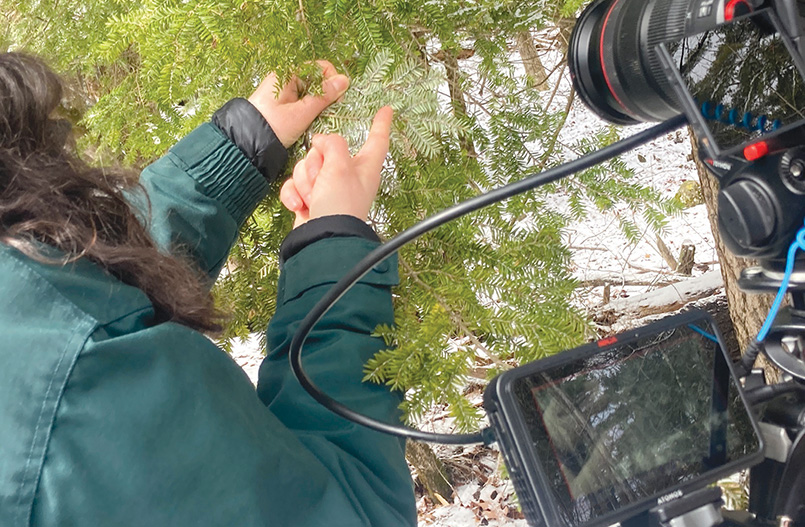
A species of silver fly, an instrument for controlling the invasive aphid-like insect hemlock wooly adelgid (HWA), has established itself in upstate New York, the Department of Environmental Conservation has announced.
The Cornell University-based New York State Hemlock Initiative (NYHI), which has been importing the bugs from the Pacific Northwest and raising the flies in its laboratory for nearly a decade, confirmed that a self-sustaining population has been documented in the Finger Lakes area.
Once established, a silver fly population will expand and spread beyond the original point of introduction, becoming part of a permanent, biological check on Hemlock Wooly Adelgid, which was first encountered on Lake George in 2017.
According to Dr. Mark Whitmore, the director of the NYHI, the discovery of a self-sustaining population of the species of silver fly, Leucotaraxis argenticollis “is huge news, offering hope for the effective biological control of HWA in the Lake George basin” and other parts of the Adirondacks where the invasive pest has been found, such as the Champlain Valley and Great Sacandaga Lake.
“Introducing a predator from another area, importing it to one where the targeted pest is enemy-free, is classic biological control,” said Whitmore. “Establishing a population of predators is one of the most difficult steps in the process, but also the most important.”
The discovery of an established silver fly population “marks an important step forward in HWA control and hemlock conservation,” the DEC stated.
If a population of silver flies has established itself in the Finger Lakes area, it is safe to say that others are now colonizing other areas of the state, where the NYHI and the DEC also released silver flies, said Whitmore.
“We just need to look for them, which is what we will be doing,” said Whitmore.
Whitmore said a recent experiment by a team of entomologists found that Leucotaraxis argenticollis, the species that established itself in the Finger Lakes, can survive winters in the coldest parts of New York State.
Laricobius nigrinus (or “Little Larry”)
Researchers are focusing their attention not only on silver flies but on a beetle, Laricobius nigrinus, also from the Pacific Northwest.
According to the DEC, the beetles feed on adolescent and adult HWA during the fall and winter while the silver flies prey on the aphid’s eggs in the spring. According to the DEC, unleashing silver flies “complements the release of the beetles.”
“The goal of these deployments of predatory insects is to establish stable populations in the area and provide long-term, year-round protection for the region’s hemlock forests,” the DEC stated.
According to the DEC, “beetles have been thriving, with established populations at 18 release sites and documented long-distance dispersal in the Finger Lakes, Lower Hudson, and Catskills regions.”
Jason Denham, a DEC Forester, speaking at the April meeting of the Adirondack Research Consortium in Lake Placid, noted, “Last year, the DEC collected 12,000 beetles from a site where they had been released previously and redistributed them across New York State.”
The success of the beetles in establishing local populations suggests that silver flies may also be able to take hold and contribute to long-term biological control, the DEC stated
Mark Whitmore emphasized that populations of both predators – the silver fly and the beetle – must both establish themselves, if not simultaneously, then at least permanently and within proximity of one another, if they are to effectively control the spread of HWA.
The Lake George Hemlock Coalition
Members of the Lake George Hemlock Coalition, which was established in 2024 to develop a unified, comprehensive approach to the protection of the area’s hemlock forests, welcomed the reports that a silver fly population has established itself in New York State.
“Biological controls have really positive implications for the future in the Adirondacks,” said Jason Denham, the DEC forester who now represents the DEC in the Lake George Hemlock Coalition. “I’m very optimistic that there will be a reliable source of predators that we can continually redistribute across New York State.”
As the largest single landowner in the Lake George watershed, New York State can’t help but play an outsized role in controlling the spread of HWA on Lake George, said Denham.
“The DEC is actively engaged in managing those lands for HWA,” Denham said.
“Bio-controls offer long-term hope that we can maintain healthy hemlock forests here at Lake George, where they can continue to deliver water quality for streams, habitat for birds and animals and scenic beauty,” said Mike Horn, executive director of the Lake George Land Conservancy. “These trees define our forests.”
According to Horn, both the beetle and the silver fly have been released at the Conservancy’s Clark Hollow Bay Preserve on northern Lake George, where HWA was discovered in 2023.
“The New York State Hemlock Initiative identified Clark Hollow Bay Preserve as a great ‘host site’ for the insects,” said Horn. “It provided us with the insects, which we released under the supervision of its researchers and technicians.”
Earlier this spring, Hemlock Initiative researchers returned to Clark Hollow Bay to determine if a population of beetles had established itself there.
“We’re very excited,” said Horn. “We hope the natural predators establish themselves and create a long-term, cyclical, predator-prey balance.”
The Lake George Land Conservancy is a founding member of the Hemlock Coalition, which also includes the Adirondack Park Invasive Plant Program of The Nature Conservancy (APIPP); the Lake Champlain Lake George Regional Planning Board (LCLGRPB); the Lake George Association (LGA); the Lake George Park Commission (LGPC); the NYS Hemlock Initiative of Cornell University; Warren County Soil and Water Conservation District; and Washington County Soil and Water Conservation District. It was created with the support of a $108,000 grant from the Lake Champlain Basin Program.
The DEC is also a member. According to the agency’s Jason Denham, “The DEC acts as the coalition’s technical advisor on how best to manage this particular pest.”
Since it was established in 2024, the coalition’s efforts to coordinate research, surveys, treatments, long-term planning and public outreach have been supported and assisted by the DEC.
“And that’s aligned with the DEC’s mission – working in partnership with groups to manage different invasive species even on lands that are not part of the Forest Preserve,” said Denham.
According to Denham, the DEC has had a Forest Action Plan since 2020 “to keep all New York forests healthy, not just those managed by the DEC. We need partnerships with groups like the Lake George Hemlock Coalition to direct technical assistance and funding to the places where it can be most helpful.”
Other Tools for Managing HWA
Over the past year, the New York State Hemlock Institute has released more than 45,000 insects naturally engineered to prey on HWA and will continue to monitor their progress in establishing themselves throughout the state, the institute stated in a press release.
Until the natural predators establish themselves in the Lake George watershed, the most effective method of controlling HWA remains insecticides, the Lake George Hemlock Coalition states. According to the DEC, two different insecticides, one fast-acting, killing the insect before it can reproduce, the other affording the tree long-term protection, are applied to bark near the base of the tree and absorbed through its tissue. When HWA attaches itself to the tree to feed, it receives a dose of the pesticide and is killed.