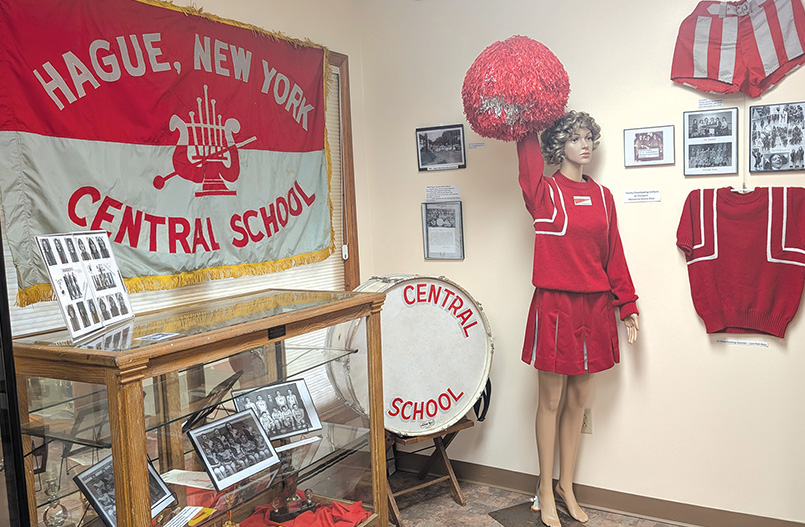
The Hague Central School had a long-time tradition, beginning in 1940, that each year the graduating class would craft a banner, to be added to the school’s collection.
The last banner was in 1978, the year before the school closed.
“Nobody made a banner (in 1979),” said Shelly Gautreau, archivist at the Hague History Museum.
School district residents had voted five times over a twenty-year period against merging with the Ticonderoga Central School District, The Post-Star reported on March 1, 1979.
The state put pressure on when it notified the district that its high school was no longer accredited, and the district must bus students in grades 7-12 to Ticonderoga.
A sixth annexation vote failed, and a seventh and final vote on June 31, without participation of the school district, passed by a vote of 242-198.
The banner collection is among the items in a museum exhibit which runs through the end of the year about the history of the school.
The museum at the Hague Community Center is open to the public free of charge any weekday, except for holidays, during regular business hours.
The school, for decades, was the social center of the town, where neighbors congregated to watch athletic contests, student concerts, student plays and community dinners.
“The last sporting event in the 51-year history of Hague Central School District was held Wednesday,” The Post-Star reported on June 14, 1979.
Hague lost 9-4 to Newcomb, finishing the season with a 3-7 record.
Martin Fitzgerald, Alvin Frasier, Ron Fuller and Mike Streeter all hit doubles for Hague.
Michael DeLarm, Bonnie Thibeault, Colleen Goetsch and Rich Strum were inducted into the National Honor Society, in a final ceremony, The Post-Star reported on June 18.
Strum later acquired the student locker he used at the school, and has loaned it to the historical society for the exhibit.
Cheerleading and athletic uniforms for the Hague Raiders, originally the Hague Red Devils, and musical instruments students played are among the items on display.
That sense of unique community evaporated when Hague was absorbed into the Ticonderoga School District after the 1978-’79 school year.
“The closing of the school, the consolidation, was really a turning point,” said Ginger Kuenzel, president of the Hague Historical Society.
The brick school was demolished, and the community center constructed at the site.
Some Hague residents she spoke with did not even know there had previously been a school at that location, said Nancy Young, the museum’s assistant archivist.
The school opened in 1927, replacing a former system of eight neighborhood schools in the town.
“They thought the school was going to cost $75,000,” Kuenzel said in a lecture to the Hague Historical Society. “It was amazing. It actually cost less and was built in six months.”
The school district spent $1,500 to buy the land and $48,500 to construct the building – a total of $50,000 – the equivalent of $959,612 in 2026 dollars.
The neighborhood schools offered instruction only through the eighth grade.
Students who desired a high school education had to enroll at out-of-town schools.
The late Clifton West, former long-time town historian, was valedictorian of the first graduating class of four students in 1928.
“When Hague Central opened it was like a palace,” West wrote in recollections about the school. “We had central heat, indoor restrooms. And in January the teacher said we could go to Washington at Easter on a (senior) class trip.”
U. S. Rep. James Parker, R-Salem, arranged for the students to meet President Calvin Coolidge while they were in Washington.
Hence, another annual tradition of the senior class trip to Washington was started.
An addition, doubling the size of the building and including a gymnasium with bleachers seating 250 people, was constructed in 1931.
Compiling the exhibit was a community effort, as residents searched their closets and attics for items associated with the school.
“Many people jumped in to make it exciting,” Young said.
Photographs, too numerous to be displayed individually, can be viewed on a large digital projection screen.
The hope is that people visiting the exhibit will recount oral history, such as the food in the lunchroom.
“There was a lot of stuff you didn’t care for – chipped beef on toast. But it was all good food – all homemade,” Gautreau said.
Beef pot pie with vegetables, whipped sweet potatoes, cranberry sauce, Jello with topping and milk were on the menu for Sept. 23, 1976, The Ticonderoga Sentinel reported at the time.
Baked pizza with cheese, tossed salad, stuffed prunes, apple sauce and milk were served on Sept. 24.
Gautreau said Rose McNamara, her kindergarten and 1st grade teacher, made an impact on her life by insisting she do exercises to correct bowed legs.
“Every day she had me walk a straight line. … And at the end, when I could finally do it, she had the whole class stand up and applaud. As a 5-year-old, that meant so much to me.” I didn’t have a bad teacher, I have to say, because it was such as small school, everyone cared for you,” Ginger Kuenzel said.