

Early childhood programs aimed at Adirondack families remain severely underfunded, leaving thousands of children without access to home visiting, early intervention and day care despite more than $36 million in public spending each year, according to a report by the Adirondack Birth to Three Alliance and the Adirondack Community Foundation.
“The current business model for child care doesn’t work,” said Kate Ryan, Director of Adirondack Birth to Three Alliance. “Unlike other businesses, child care providers can’t use standard tactics like reducing staff, increasing sales volume, downsizing space, or cutting hours.”
And according to the Adirondack Community Foundation and Warren County EDC, whose leaders convened a gathering at Fort William Henry’s Carriage House on October 29, this is, or should be, “everyone’s business.”
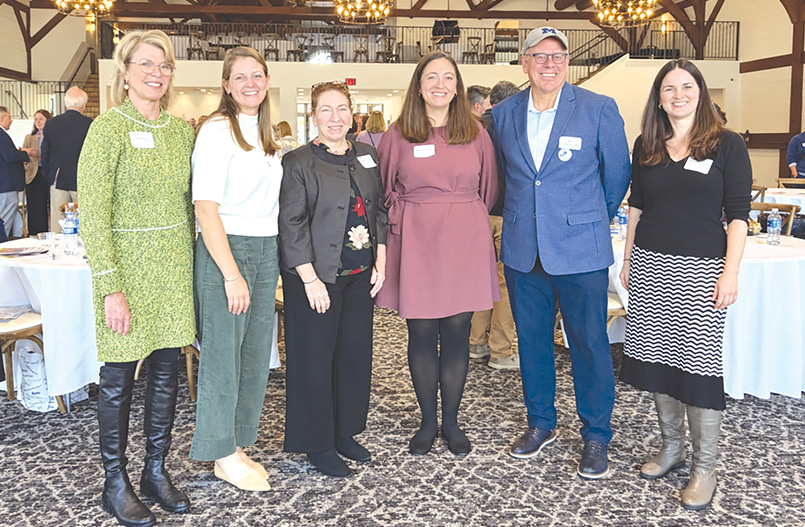
“Child Care Is Everyone’s Business: Building a Stronger Adirondack Region,” which was billed as the launch of a five-county coalition to address one of the region’s more intractable problems, drew business owners, non-profit executives, elected officials, child care professionals and a roster of speakers that included Lisa Guide, Associate Director of The Rockefeller Family Fund, EDC chair Melanie Weber, Jen Russell, vice president of grants and programs at the Adirondack Community Foundation, EDC president Jim Siplon and Kate Ryan.
By enlisting the support of the business community for a broadened effort to expand access to child care throughout the region, the Adirondack Community Foundation and the EDC hope to “turn early childhood care into a core economic development agenda,” said Jen Russell.
For that to happen, “we need business and economic development leaders at the table,” said Russell. “Educators and families cannot solve the child care crisis at an Adirondack Park-wide scale alone.”
The partnership between Warren County EDC, a traditional vector for connecting the region’s most important employers, and Adirondack Community Foundation has “created the table where business leaders not only listen, but help design solutions,” said Russell.
Healthcare, hospitality, banking and manufacturing are among the sectors which have been represented in meetings over the past year, helping to document the many ways in which lack of access to child care has limited the ability of every industry and service provider in the Adirondacks to recruit and retain employees.
“Child care is foundational infrastructure; it should be treated as the economic imperative it is,” said the Rockefeller Family Fund’s Lisa Guide. “Child care is also one of the most direct routes to economic mobility, especially for women.”
According to recent statistics, only one slot is available for every six children in need of child care in the Adirondacks. Thus even families who qualify for federal public assistance – 92 in Warren County alone – may have difficulty finding providers with space for their children.
A 2024 study by the Adirondack Community Foundation reported that the region lost approximately 20% to 25% of its regulated child care capacity over the preceding two years, leaving 80% of the region a “child care desert” – an area where at least three children under the age of 5 compete for every available child care slot.
As Jen Russell noted, support for the new collaborative effort – from data collection to the hiring of Mary Feldman, the former director of the Rutland County (Vermont) Parent Child Center to serve as “Transformational Change and Rural Childcare Lead” for the five-county region – has been provided by the Rockefeller Family Fund.
Lisa Guide, who happens to have a home in North River, told the conference that the Rockefeller Family Fund has committed more than $500,000 over a two-year period to the collaborative effort.
“We fund work at the state and local level because that’s where solutions get tested and proven,” she said. “If a model works in the Adirondacks, it could work in other rural areas as well. It could change the national debate, giving advocates and policy makers something concrete to build upon.”
One dimension of such a model might be a more equitable method for reimbursing child care providers in rural areas, one that covers the actual cost of providing quality care and enables providers to pay competitive wages, maintain facilities, meet regulatory requirements and remain financially viable.
(A 2024 fiscal analysis by the Adirondack Community Foundation found that the cost of providing infant care in a licensed center is $25,584 per child per year; only $15,996 is reimbursable, a shortfall of $9,588 per child)
A priority of the new coalition will be changing the way New York State reimburses child care providers – something for which it will advocate in Albany in the coming year, its partners state.
“The resource allocation model for the Adirondack Park doesn’t work. It’s based on population density, when the whole concept of the Park goes against that,” said Jim Siplon.
2027 will be an opportune moment to insist that because the Adirondack Park has been set aside as a unique place, its unique needs should be acknowledged, said Siplon.
“New York State wants to spend billions of dollars to expand childcare,” said Siplon. “The needs of this area can be addressed in this investment.”
Kate Ryan agrees. “There is now so much energy around childcare now. Our region is uniquely positioned to take advantage of an unprecedented increase in funding.”
According to Lisa Guide, “the momentum to write these funding formulas and policies to fit rural communities is gaining.”
Moreover, she said, “New York State is more apt to be open to proposals to revise funding formulas if the Governor and the legislature hear from the people who sign the checks – the business owners – and not just the parents and advocates.”
Assemblyman Matt Simpson, who attended the October 29 discussion, said he will carry the coalition’s message to Albany when the state legislature reconvenes in January.
“The current programs need to change if they are to work for our communities. Traditional formulas for funding any kind of infrastructure – from clean water to child care – frequently won’t work for the Adirondacks. We need alternatives,” said Simpson.
“If we miss the opportunity to expand child care capacity in the Adirondack Park now, we will miss the opportunity to make this place more livable and sustainable,” said Jim Siplon.

