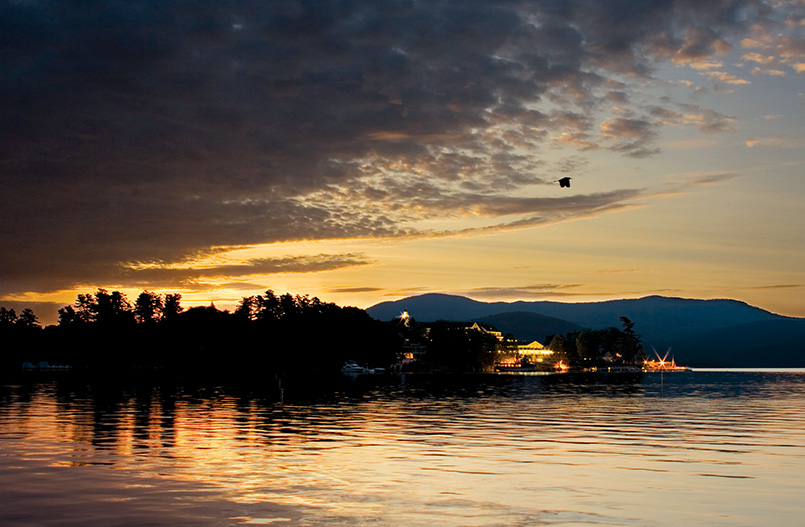
Bolton is running a race with Schroon Lake, Lake Placid and other communities to become the first town in the Adirondacks to regulate outdoor lighting to protect the night skies.
It is also in a race against time. According to astrophotographer Wayne LaMothe, light pollution in Bolton has increased significantly over the past fourteen years.
“In 2012, I could see the Milky Way end to end. Today, I can see perhaps a third of it – just the center,” the former Warren County Planning Director told the Bolton Town Board on August 4.
“What does that mean?” he asked. “It means the impacts are everywhere.”
Light pollution affects wildlife, including bats and migrating animals, diminishes residents’ quality of life and threatens an important tourism asset, he said.
LaMothe was just one of a number of residents to address the board during a session that was officially labelled a public hearing on a proposed law to regulate and limit outdoor lighting.
Unfortunately, few have seen the draft legislation and those who have found it incomprehensible.
“It needs clarity,” said Planning Board John Gaddy, who has advocated for dark skies more forcefully and for more years than any other single resident. “I hope this is just the first step and that we can get these definitions and technical specifications straightened out so people can understand what we’re trying to do here.”
According to town officials, compliance with dark sky standards ought to be a condition for a development’s approval and for a certificate of occupancy. The ordinance should also be enforceable.
If Bolton’s 2025 Comprehensive Plan is any indication, support for such an ordinance would be widespread, despite, or perhaps because of, the lack of progress in the past.
The Comprehensive Plan affirms that Bolton’s night skies are not merely an environmental amenity but an essential part of the community’s identity.
“There was limited progress updating regulations as suggested in the 2003 plan,” the document states, “but stakeholders are expressing a renewed interest” in controlling lighting and preventing excessive glare.
According to the plan, reducing light spill would help preserve “the distinctive character of the Lake George basin” and allow residents and visitors to experience a night sky free of urban glare.
At the August 4 meeting, several residents echoed those views, stating that Bolton’s views of the night sky are among the community’s defining characteristics and an attraction for visitors.
As proof that dark skies are an attraction, John Gaddy cited a proposal by Bolton Chamber of Commerce director Elaine Brown to publish the work of the astrophotographers in its tourism brochures.
Lake George Waterkeeper Chris Navitsky urged the Town Board to move forward with regulations addressing the number, brightness and direction of outdoor lights.
“Bolton has already made significant progress, and I applaud you for that. Bolton is the first town in the Lake George area to look at this issue and I urge you to keep going,” he said.
Across the Adirondacks, communities such as Lake Placid, Schroon Lake, Raquette Lake, Tupper Lake, Johnsburg and Horicon are beginning to develop policies aimed at reducing light pollution.
The Wild Center in Tupper Lake has become one of the region’s leading advocates for dark-sky preservation through public education and partnerships promoting responsible outdoor lighting.
Several other organizations have taken a more direct role in encouraging municipalities to adopt local lighting standards.
The Adirondack Council has urged Adirondack towns and villages to enact dark-sky ordinances. The Adirondack Park Agency has long recommended that outdoor lighting be limited to what is necessary, directed downward and designed to minimize glare and light trespass while preserving the park’s nighttime environment.
Most model ordinances would not prohibit outdoor lighting. Instead, they generally would require new residential fixtures to be fully shielded, use warm-white bulbs of 3,000 Kelvin or less, and prevent light from spilling onto neighboring properties. Commercial developments typically would face stricter standards, including limits on parking lot lighting, sign illumination and decorative uplighting.
The Bolton Town Board will extend the public hearing on its proposed ordinance at least through its September meeting, which will be held September 1.