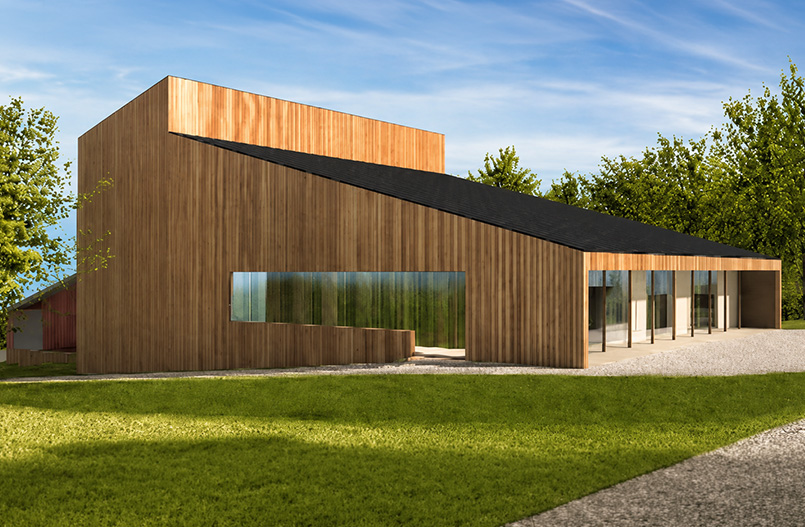
A planned year-round performing arts center for the southern Adirondacks has advanced a step or two further: the Seagle Festival in Schroon Lake has been awarded a $1.8 million grant from the New York State Council on the Arts’ Capital Projects Fund.
According to Tony Kostecki, the Seagle’s General Director, the state grant will help fund the construction of a new dining and conference hall at the rustic music education center – one component of a new, $30 million year-round campus.
The other two components are a 250-seat, state-of-the-art opera hall and two, eight-bedroom cottages to house the Seagle’s artists.
“The great thing about these buildings is that all of them will be winterized,” said Darren Woods, the Seagle’s Artistic Director. “We now cease operations in October because the campus is unlivable after that. We have to turn the water off because the pipes will freeze.”
For the Seagle, which has been a summer-term, singers’ conservatory for more than one hundred years, “the possibilities of a year-round performing arts destination are endless,” said Woods.
“We can produce programs for young people when schools are in session, not just in summer. We can present professional productions of opera and musicals throughout the year, which we can’t do now because our current theater is a small converted, unheated, Adirondack barn with no air conditioning. We will also be able to host conferences, meetings and retreats,” said Woods.
“We also envision our year-round opera hall and campus as a regional resource,” said Tony Kostecki. “We want this to be a place where the Glens Falls Symphony groups north of Schroon Lake could perform.”
As a combination performance venue and educational institution, a place that is oriented toward students as much as it is toward audiences (and in reality, much more), the Seagle needs facilities that serve both functions.
They no longer do, both Woods and Kostecki said.
“Our training and campus facilities have outlived their usefulness; they do not match the caliber of artists that we attract,” said Darren Woods. “We are still the very first choice for singers applying to training programs. But we have two other competitors.”
“Other programs have new or upgraded facilities and that will be a draw if ours have deteriorated to a point where they’re no longer usable,” said Kostecki. “Facilities have to be state-of-the-art if they’re to give our singers a professional experience.”
This fall, the Seagle’s administration expects to start prepping the land for development and modernizing the new campus’ invisible but nonetheless necessary infrastructure – water, power, wastewater systems.
“We’re basically building a small town up here,” said Kostecki.
According to Kostecki, all three components are expected to be completed by 2030.
“The opera hall will be built last, because that requires the greatest amount of money, which we are in the process of raising,” said Kostecki.
In announcing the grant, New York State officials emphasized the numerous economic, civic and social impacts of the arts.
“Our continued investments in museums, theaters, and art centers generate incredible returns — sparking innovation, boosting local economies, driving visitors, and making us the global epicenter of arts and culture,” said New York Governor Kathy Hochul.
Erika Mallin, the executive director of the New York State Council on the Arts (NYSCA), said, “We know that when the arts flourish, communities follow — bringing energy, creating jobs, expanding accessibility, and increasing tourism. The New York State Council on the Arts’ Capital Projects grant program is a critical investment in our creative sector.”