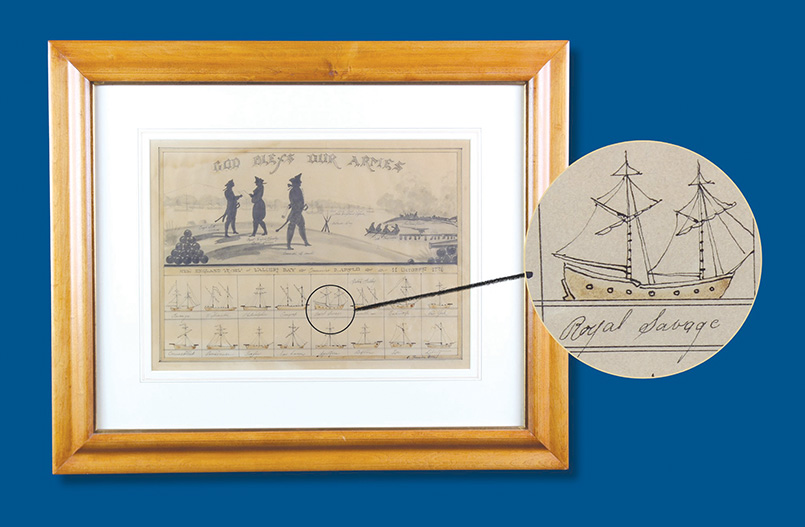
Artifacts from the Revolutionary War-era schooner Royal Savage, once lost beneath Lake Champlain for more than a century, are in the process of being preserved by Fort Ticonderoga, the Lake Champlain Maritime Museum and the National Museum of the U.S. Navy in Washington, D.C.
Fort Ticonderoga’s artifacts include two 6-pound cannon carriages, three iron shot, a curved ship’s timber, and a small gun carriage truck or wheel, all recovered from Lake Champlain in the early 1900s.
According to Beth Hill, President and CEO of Fort Ticonderoga, Fort Ticonderoga will partner with the Lake Champlain Maritime Museum (LCMM) Artifact Conservation Laboratory to stabilize and preserve its artifacts.
The project is funded with support from the Champlain Valley National Heritage Partnership (CVNHP).
“These objects are among the rarest survivors of the American Revolution on Lake Champlain,” said Hill. “Conserving and displaying them in time for the 250th anniversary of Valcour Island is exactly the kind of work that defines our mission and we are grateful to our partners at the Champlain Valley National Heritage Partnership for making it possible.”
After a century out of the water, these objects are in urgent need of conservation treatment, said Hill.
The vessel, originally built by the British in 1775 and later captured by American forces, served as the flagship of General Benedict Arnold’s fleet in the dramatic Battle of Valcour Island.
In October 1776, Arnold commanded the small American fleet on Lake Champlain to monitor and contest the British advance southward.
On October 11, the fleet engaged a larger British force off Valcour Island. The Royal Savage ran aground during the battle, was captured, and burned. Though the Americans suffered heavy losses, Arnold showed the British they faced determined American resistance.
The battle may also have played key role in delaying British forces, buying time for the Continental Army and contributing to the eventual American victory at Saratoga in 1777.
After sinking in 1776, the remains of Royal Savage lay submerged for 158 years before being salvaged in 1934. More than 2,000 artifacts were recovered, including weaponry and personal items.
Fort Ticonderoga’s artifacts, including one of the cannon carriages, will be featured in a new exhibit at Fort Ticonderoga commemorating the 250th anniversary of the 1776 Campaign and the Battle of Valcour Island. Other artifacts are now being prepared for public display at the National Museum of the U.S. Navy in Washington D.C.
Decades of poor storage and mismanagement followed the salvaging of the Royal Savage, culminating in a controversial attempt by the city of Harrisburg, Pennsylvania, to sell the artifacts online in 2013.
The Naval History and Heritage Command (NHHC) intervened, asserting federal ownership under laws protecting sunken military craft. In 2015, the city formally transferred the artifacts to the Navy, launching its own long-term preservation effort.
“This ship and its artifacts are now going to be preserved and cherished for the public for generations to come,” said Harrisburg Mayor Eric Papenfuse at the time of the transfer.
NHHC Director Samuel J. Cox stated that the Navy has a proven commitment to safeguarding its heritage and advancing research opportunities.
Since then, conservators and archaeologists have undertaken extensive scientific work to stabilize the artifacts, many of which had deteriorated due to exposure and earlier preservation attempts. Techniques have included chemical treatments, desalination, and advanced imaging technologies.
In addition to physical conservation, researchers have digitally reconstructed the vessel using photogrammetry and laser scanning.
These efforts enabled the creation of detailed 3D models and two precise 1:12 scale replicas, built through a partnership with Texas A&M University.
The models and preserved artifacts will form part of a future exhibit at the National Museum of the U.S., offering the public a detailed look at one of the earliest vessels in American naval history.
As the United States approaches its 250th anniversary, officials say the project highlights the importance of maritime archaeology in preserving national heritage.
The Royal Savage “stands as a testament to the endurance of the American spirit,” the NHHC said, noting its journey from battlefield loss to historical centerpiece.
At Fort Ticonderoga, visitors will be able to see its newly conserved objects as of this this fall, when the museum hosts a panel of scholars for a special conference “Arnold’s Defeat or Ultimate Victory? Perspectives on the 1776 Campaign,” October 9-11, 2026.
Few physical traces of the 1776 Battle of Valcour Island have survived. The conserved artifacts of the Royal Savage at Ticonderoga and Washington, D.C. will join an extraordinary group of survivors that include the gunboat Philadelphia, now also undergoing conservation and re-interpretation at the Smithsonian’s National Museum of American History.