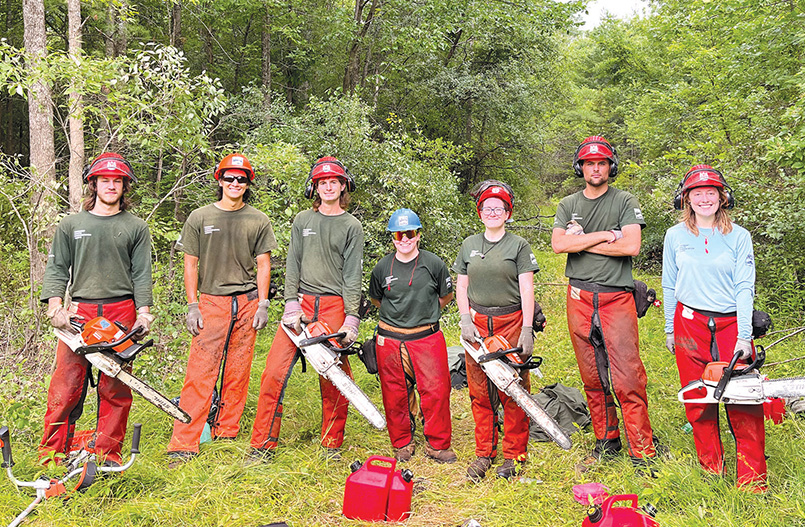
The Lake George Land Conservancy is midway through the first year of a multi-year habitat restoration project at its Cook Mountain Preserve at the lake’s north end.
According to the LGLC, the preserve’s 32 acres of wetlands, forests and overgrown farmland have been breached by invasive species; as part of the project, these will mostly be eradicated, allowing the natural landscape to revive and flourish.
“Invasives move at warp speed, giving them an unfair advantage over native species,” said Sarah Hoffman, the LGLC’s ’s Communications and Outreach Manager. “By removing them, we’re giving nature time to catch up and allow the land to evolve into what it would have become without the interference of human-introduced invasives.”
Mike Horn, the Lake George Land Conservancy’s executive director, said, “It’s the right thing to do for the land.”
The conservancy has contracted with the non-profit Vermont Youth Conservation Corps to carry out the initial phase of the restoration. Before completing this summer’s work in mid-August, a field crew of six to eight people will have spent seven weeks removing dense stands of invasive shrubs across the preserve.
Hiking trails at the preserve have remained open throughout the work, although visitors are asked to avoid active work areas.
Building a Stewardship Team
This summer’s LGLC Stewardship Intern, Matthew Sieber-Ford, will continue the work of the project as the organization’s most recent hire and as a new member of its stewardship team.
“The Cook Mountain Restoration Project is a phenomenal example of doing more with more,” said Mike Horn. “We can leverage outside expertise and vendors, but we also need in-house expertise. That’s what we’re building – a stewardship program within the LGLC.”
A Cascade of Effects from Invasive Plants
According to Matthew Sieber-Ford, Common buckthorn, invasive bush honeysuckle and Japanese barberry were identified as primary targets during the early stages of the project.
“These successfully compete with native vegetation for sunlight, water and nutrients, producing a cascade of negative effects on the habitat; on a myriad of other plant species, on birds, mammals, insects and even the soils,” said Sieber-Ford. “Common buckthorn, for example, has been shown to alter soil chemistry, making it less habitable to other plant species and creating favorable conditions for additional invasive growth.”
Buckthorn is particularly widespread at the preserve, where some plants have reached tree size, shading and further constraining the growth of native species. Its fruit is readily dispersed by birds and seeds can remain viable in the soil for up to six years, making long-term management necessary.
“The more these invasives spread, the fewer opportunities the native species will have to thrive; the diversity of species at Cook Mountain will continue to dwindle,” said Sieber-Ford.
A Strategy for Controlling Invasives
The Cook Mountain restoration project combines both large-scale and selective clearing of invasive shrubs.
After a few consecutive years of suppressing invasives, the LGLC will be able to restore the area with native vegetation.
By restoring the natural habitat, deploying resources, investments and focused, sustained efforts over time, “we can reverse these negative cascading effects and replace them with positive cascading effects,” said Mike Horn.
To come upon areas untouched by invasives is to discover what a restored landscape will produce, said Sieber-Ford.
As an example, he cited the discovery of a wetland that had once been a beaver pond, “teeming with willows, red maples cottonwoods and all kinds of wetland species. It was a microcosm of invasive-free areas.”
A History of the Cook Mountain Preserve
The current restoration effort builds on decades of stewardship at Cook Mountain, the conservancy’s first public preserve.
The property traces its history to the late 19th century, when George Delano farmed the slopes of Cook Mountain, maintaining maple sugar bushes and apple orchards whose fruit was shipped to New York City. Nearly a century later, his grandchildren, Donald and Marjorie Delano, donated 152 acres to the LGLC, establishing the preserve. An additional 18 acres were donated in 1995 by Dr. and Mrs. George Boyle.
Today, the preserve encompasses trails overlooking Lake George, Lake Champlain and Vermont’s Green Mountains. While remnants of the former orchards remain, much of the lowland has reverted to forest and wetlands, conditions that have allowed invasive terrestrial plants to spread.
Conservancy staff and volunteers have worked for more than two decades to control the infestations, but Sarah Hoffman said the scale and density of the invasion exceeded what a small volunteer workforce could effectively manage. Mike Horn said restoring native vegetation will have benefits beyond the preserve itself. The Cook Mountain wetland complex drains into a stream that flows into Lake George. Replacing invasive shrubs with native wetland plants is expected to stabilize soils, reduce erosion, improve water quality and strengthen the watershed’s resilience to climate change while creating healthier habitat for native wildlife. Long-term adaptive management will be used to ensure the restored plant communities become established and remain healthy.