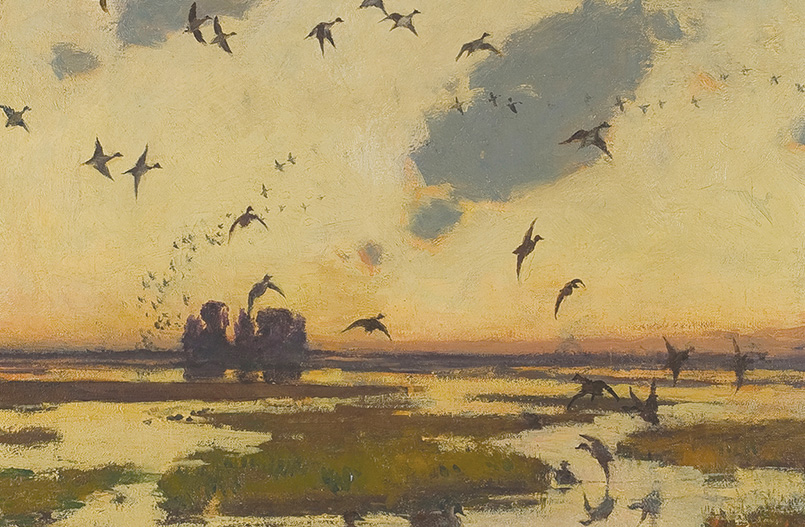
Depending upon your interests and mood, you might wish for more birds and fewer landscapes in The Hyde Collection’s “Wings and Wilderness: Birds and Landscapes of the Northeast.”
But it takes only a moment’s reflection to realize that without these specific landscapes, or habitats, there would hardly be any birds at all.
That is especially true of New England, whose Museum of American Bird Art at Mass Audubon (MABA) in Canton, Massachusetts, is the source of many of these art works.
Relatively little of the mature, undisturbed habitat needed by the native woodland birds of the region remains intact.
According to a recent report, the “Wildlands in New England,” only 3% of New England’s landscapes and less than 4% of its forests are permanently protected as wildlands. Old-growth forest — marked by ancient trees, standing dead trees, fallen timber and complex soils — accounts for less than one-tenth of 1% of the six-state region.
That realization might add a touch of sadness or wistfulness to your appreciation of the exhibition, which will remain on view through October 11.
As MABA’s director, Jennifer Tafe, put it in a June 11 lecture at The Hyde, “as the fragility of nature… has become more apparent… the manner in which nature subjects have been used in art has changed over time.”
Of course, not only old growth forests are vulnerable to commercial, agricultural and urban development; so, too are other kinds of bird habitat, islands such as Matinicus, captured by George Bellows in “Freeman Young’s Place (Matinicus Island)” and Hupper Island, the subject of Andrew Wyeth’s “The Ledge and the Island.” Also, tidal wetlands, or the Nauset marshes portrayed by Frank Benson in “The Duck Marsh,” an area now included in the Cape Cod National Sea Shore.
Nauset Marsh
Henry David Thoreau first tramped through the Nauset marshes in 1849 – the “Plains of Nauset,” he called them, “where in winter the winds howl and the snow blows right merrily in the face of the traveler.”
Thoreau has little to say about Cape Cod’s birds. As Henry Beston wrote, “By temperament, Thoreau was probably more of a botanist than an ornithologist; plants did not move and gave him time both to observe and consider.”
It is a deficit that Beston himself does more than enough to remediate.
“How singular it is that so little has been written about the birds of Cape Cod,” he commented in “The Outermost House,” his 1928 account of living in a shack he named “Fo’castle” and which he built himself on the outer or back beach, not far from the Nauset Marsh where Benson himself built a rustic hunting camp.
“There are hidden pools in these uninvited acres which only sunset reveals,” Beston wrote of the Nauset Marsh. “The wild ducks know them well and take refuge in them when stalked by gunners.”
In addition to marsh birds, Beston observed “land birds, moor birds, beach birds, sea birds, coastal birds, even birds of the outer ocean.”
“From an ornithologist’s point of view, Cape Cod is one of the most interesting peninsulas in the world,” he wrote.
Wildlife Refuges
John F. Kennedy is commonly acknowledged to have played the leading role in the creation of the Cape Cod National Sea Shore, both as a US Senator from Massachusetts and as President, co-sponsoring the legislation to create the preserve and signing it into law in 1961.
But Kennedy’s interests in creating wildlife refuges were not confined to Cape Cod, however closely he may have been identified with the Cape in the public mind.
When campaigning for the presidency in 1960, the Great Lakes were at the top of his mind.
“Kennedy spoke passionately about establishing national lakeshores and national migratory waterfowl refuges in the ecologically struggling Great Lakes region,” the historian Douglas Brinkley writes in his recent “Silent Spring Revolution: The Great Environmental Awakening.”
According to Brinkley, Kennedy – and Lyndon Johnson, who inherited Kennedy’s environmental legislation and his initiatives – designated scores of areas as national wildlife refuges during their years in office,
William Merritt Chase’s 1866 “Landscape, near Coney Island,” which portrays a low-lying coastal landscape, is perhaps the closest approximation in the exhibition of the marsh lands and refuges protected in the 1960s.
An endangered water bird, the Black tern, once common on the St. Lawrence River and Lake Erie, whose habitat was lost or compromised through the industrial manipulation of water levels, PCBs and other pollutants and human disturbance, is now flourishing in one of the Great Lakes refuges created during the Kennedy administration.
The Loon and Bucknell’s Thrush
The Black tern reminds us that birds are not only convenient avatars for the places that we wish to preserve. They are also representative of the greatest threats to those places. In the Adirondacks, think Loon and Bicknell’s Thrush. Both have an inductive proxy in Winslow Homer’s “A Good One, Adirondacks.”
When compared with New England, we may think the landscape and wildlife habitats of the Adirondack Park are extremely well protected. In fact, a campaign to preserve 10% of New England as “wild lands” is expressly inspired by the six-million-acre Adirondack Park.
But according to a report from the Department of Environmental Conservation, “Conservation of Boreal Birds in the Adirondack Park,” by Michale Glennon, several bird species associated with the Adirondack Park’s boreal wetlands have declined substantially over a recent 16-year period.
Nationally, the forest habitats of birds face threats from decades of fire suppression, invasive pests, development and climate change, according to the Nature Conservancy.
Silent Springs
If we hear we hear less birdsong these days, that is because there are fewer birds.
That much is evident in the National Audubon Society’s annual Christmas Bird Count, sponsored here by the Lake George Land Conservancy. Since 1991, the Conservancy has been Audubon’s designated compiler of all data collected within a 15-mile radius of Bolton Landing. That data helped scientists establish that bird populations in North America have dropped by 29% since 1970, as a study published in Science magazine in September 2019 showed.
An update of that 2019 study, presented in 2025, found that bird populations across the United States continue to decline, with the losses touching the majority of all bird groups and habitats.
The Hyde Collection’s “Wings and Wilderness: Birds and Landscapes of the Northeast” reminds us of all the species we are likely to lose as a result of climate change, pollution and disruptions to the landscape.
According to Dr. Kenneth Rosenberg, the lead author of the 2019 study, common backyard birds “are literally the canaries in the coal mine…The loss of bird populations is an indicator of what’s going on in our environment. Mass declines signal trouble across ecosystems and alert us to trends that will ultimately affect human health and well-being.”
“Wings and Wilderness” also reminds us that if we have any power whatsoever to preserve bird species– and our own health and well-being – it will be through protecting or restoring wild landscapes before it is too late.