
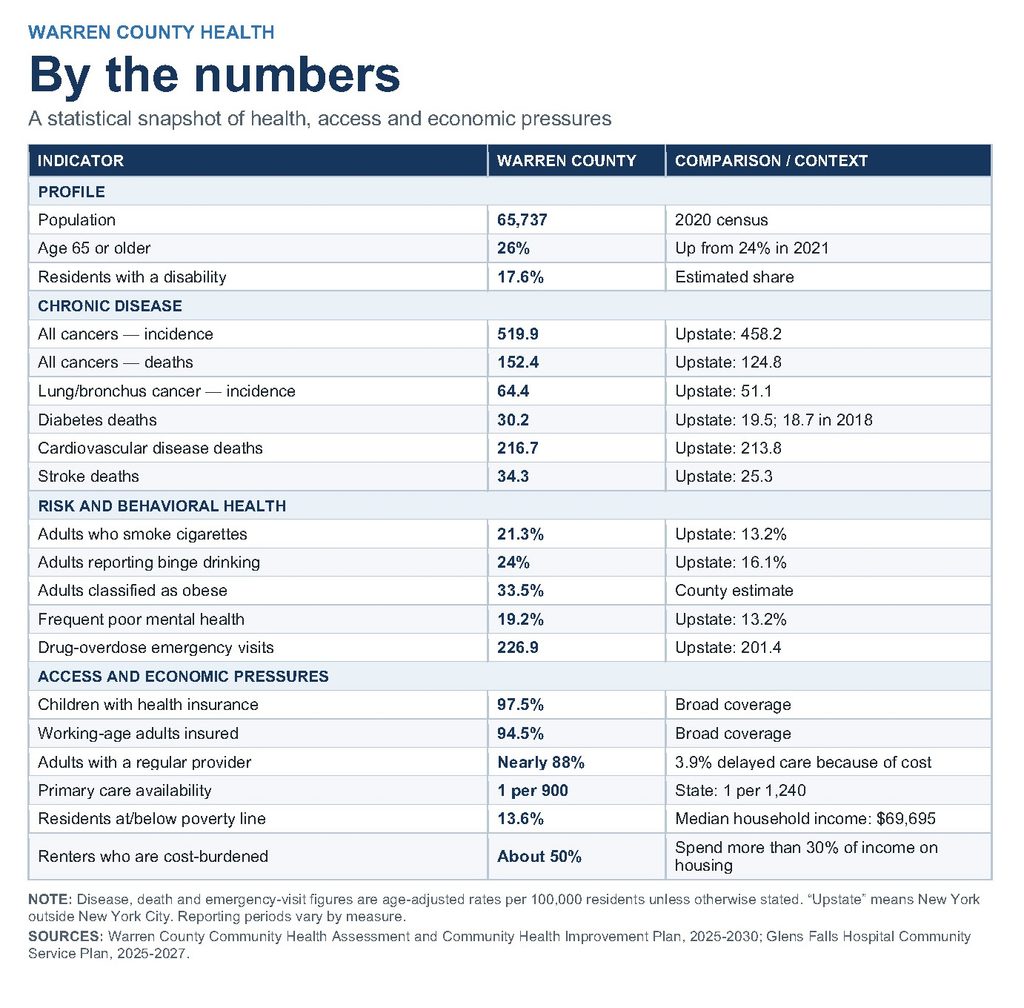
Warren County ranks among the healthier counties of upstate New York, with a high percentage of the population covered by health insurance, widespread access to primary care, a relatively high median income and low rates of unemployment.
Nevertheless, the overall health of Warren County’s population faces significant headwinds from, among other things, the cost and availability of housing, mental illness, substance abuse and an aging population with its own set of challenges, from higher rates of heart disease, stroke, arthritis, dementia, falls and cancer, to an unmet demand for long-term care.
“As a public health department, we rely upon partnerships within an extensive network of health care and community organizations; this enables us to direct people to the services and facilities they are most in need of,” said the county’s Senior Community Health Educator, Dan Durkee.
The current state of public health in Warren County is described in detail in the Health Services department’s recently completed “Community Health Assessment” and its “Community Health Improvement Plan for 2025-2030,” as well as in the Glens Falls Hospital’s “Community Service Plan, 2025-27.”
According to Durkee, County officials developed the plans with Glens Falls Hospital and representatives of other health providers, local agencies and community organizations.
“We met regularly to establish our priority areas, based on what we knew to be our biggest issues,” he said in an interview on September 2.
The planning group identified four priorities: housing stability and affordability; anxiety, stress and mental health; prevention of substance abuse and overdoses; and childhood behavioral health.
“Public health has become a comprehensive aggregation of all things that impact a population’s health,” said Durkee. “You will hear people ask, ‘How are these public health issues?’ I’ve asked that same question.”
Housing was identified as a health priority because insecure living arrangements can disrupt access to medical care, social services and social networks, Durkee said.
Rents and home prices rose sharply during and after the COVID-19 pandemic as second-home buyers and others with the means to outbid locals purchased property in the region, he said. The resulting pressure on the housing stock continues to affect seniors struggling with rent or property taxes as well as young adults and families unable to afford their first homes.
“People who don’t have a stable place to live and move frequently often struggle with finding community support and resources,” Durkee said.
The issue of housing is an example of how public health has expanded beyond the control of communicable diseases to include the social and economic conditions that can have a major influence on people’s health and well-being, said Durkee.
Of course, the county health department cannot build housing, Durkee said.
“But we can say, ‘Here is what we’re seeing in our communities. Here’s what we know could be contributing to poor health outcomes. And here are some ideas that could mitigate the worst outcomes,’” said Durkee.
Mental health problems also have become more pronounced since the pandemic, Durkee said. Younger residents report anxiety and stress, while older adults with limited mobility and fewer opportunities for social contact experience depression and loneliness.
As the county health department does not have its own mental health unit, establishing partnerships is essential, he said.
“One reason why people don’t seek care or services is that they don’t know it is available,” Durkee said. “Part of our role at Public Health Services is to raise awareness of what is available and to put people in touch with those services.”
The opioid crisis and other forms of substance abuse have yet to fully subside, Durkee acknowledged. The county has worked with the Alliance for Positive Health to promote naloxone, commonly sold under the brand name Narcan, and make it more widely available. The medication can reverse an opioid overdose.
The county is also beginning a youth anti-vaping campaign financed through settlement money from electronic-cigarette manufacturer Juul. Durkee said health educators also work with schools regularly to provide resources on an array of health topics.
Another emerging concern is declining confidence in routine immunizations. Warren County’s immunization rates remain strong, Durkee said, but health officials should not be blind to a vaccine hesitancy that is spreading across New York and the country.
If vaccination rates fall, “We’re going to start seeing diseases we hadn’t seen in decades,” Durkee said.
He said social media algorithms can deepen public mistrust by repeatedly presenting users with similar claims, regardless of their accuracy.
“We in public health services must be a trusted source,” Durkee said.
In the aftermath of the pandemic, rebuilding trust is one of public health’s broader challenges, he said. Unintentionally confusing, contradictory messaging during an unprecedented emergency alienated some residents, he explained.
“Rebuilding that trust requires being out there, explaining why we think some practices are best and then allowing officials and the public to make those decisions,” Durkee said.
Warren County’s steadily aging population presents a more intractable challenge. Durkee, who has worked on the county’s community health assessments for roughly 20 years, said he has seen the percentage of Warren County’s residents 65 and older increase over time.
That trend raises the prevalence of cancer, diabetes and other chronic illnesses and adds pressure to hospitals, urgent care centers and specialists.
Although many of Warren County’s health challenges are beyond the reach of any single agency, Durkee said the county can provide data, explain the health implications of public policy and connect residents with organizations equipped to help.
“Ultimately, our goal is to advocate for the incorporation of health and wellness in every aspect of public policy,” he said.
Glens Falls Hospital Addressing the Social Determinants of Health
Glens Falls Hospital plans to screen all patients for problems such as food insecurity, unstable housing and lack of transportation as part of a three-year effort to address some of the region’s most pressing public health needs.
The screenings are among several initiatives outlined in the hospital’s 2025-2027 Community Service Plan, which focuses on rural residents of Warren, Washington and Saratoga counties with low-incomes and limited access to health care and community services.
According to the Plan, the hospital will work with Healthy Alliance, which coordinates a network of 1,300 health care and community service sites across 24 counties. Patients identified as having unmet social needs will be connected with organizations providing food, housing assistance, transportation, household goods and help obtaining benefits.
The initiative is intended to address those needs before they contribute to medical emergencies or prevent patients from receiving care.
The hospital will also join Honest Health, an organization serving Medicare patients covered under traditional fee-for-service plans. That program will emphasize preventive screenings, testing and early detection of medical problems.
Clinicians will also receive training intended to improve documentation of patients’ conditions, enabling the hospital to assess risks more accurately and better tailor care to patients’ needs.
The two new projects are part of a broader public health strategy that includes tobacco prevention and smoking cessation, cancer screening, school wellness programs and hearing screenings for children.
Through its Health Systems for a Tobacco-Free New York program and the C.R. Wood Cancer Center, the hospital will continue efforts to reduce cigarette and electronic cigarette use, including among people with behavioral health conditions.
The hospital’s Cancer Services Program will continue connecting uninsured and underinsured residents with preventive screenings. Its Creating Healthy Schools and Communities initiative will work with schools to promote healthier environments and habits, while its audiology program will provide hearing screenings and follow-up services for children.
Hospital officials said mental health conditions emerged as the leading concern among participants in the regional community health assessment. However, the hospital did not develop a broader mental health and substance-use strategy because of limited resources and capacity. It said it would pursue regional partnerships to address shortages of those services.
Housing and transportation, also identified as serious regional problems, are not separate components of the formal action plan. The hospital said it lacks the resources and expertise to address those issues independently but will continue working with community organizations.
According to the plan, the hospital’s progress will be monitored in cooperation with the three counties’ public health departments, with programs adjusted as needed based on participation and results.