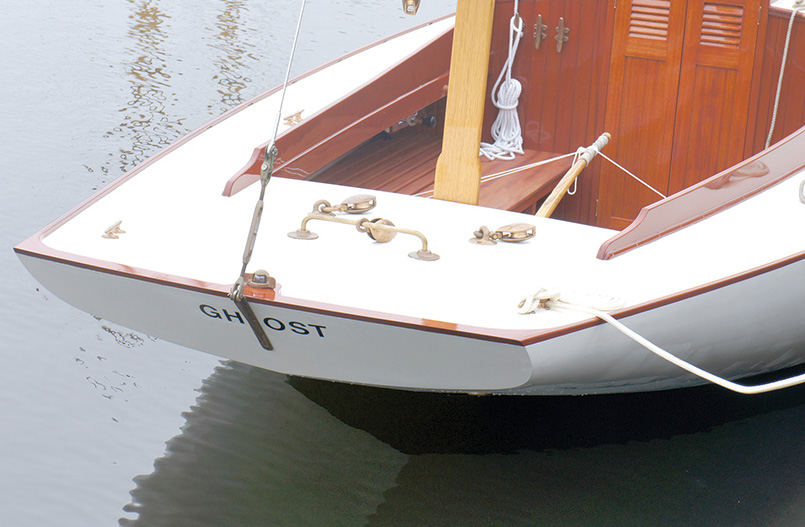
Reuben Smith, owner of Tumblehome Boat Shop in Warrensburg, is not only responsible for restoring three Sound Interclubs – the one-design sailboat once raced on Lake George – but for recovering an all but forgotten chapter of sailing history.
That, at any rate, was the conclusion of Wooden Boat magazine, which featured Smith and sailor-owner John Kelly in a 2015 cover feature.
Smith commemorated the 100th anniversary of the class of boats with a program chronicling its history and his and Kelly’s self-appointed mission to bring it back to life at the Bolton Museum on August 6.
According to Smith, the Sound Interclub originated in 1925, when yacht clubs around Long Island Sound commissioned designer Charles D. Mower to create a smaller, affordable alternative to a 6-Meter yacht.
Over the course of one winter, between 1925 and 1926, Henry Nevins, who ran the premier yacht yard of the era at City Island, built 27 of them.
“The owners were all significant figures in American yachting,” said Smith. “Many of them became famous for skippering America’s Cup defenders.”
Known for their speed, grace and athleticism, the boats were raced extensively off Long Island and Connecticut, with every race being covered by The New York Times, among other newspapers and magazines, said Smith.
“The whole idea behind one-design racing is that it’s a test of skills; it has nothing to do with who has the most money or the best technology,” he said.
“These guys really went out in any kind of weather. Only one was lost – in a squall during a society regatta,” Smith said.
Throughout the early 1930s, the boats would travel nearly every year to Bermuda for international team racing – a challenge to the Long Island fleet’s preeminence that ultimately led to its demise.
“The sailors realized they needed to up their game, so they switched to a new class of boats – the International One Design,” said Smith.
Even the yachting world’s most knowledgeable people assumed that this was the end of the Sound Interclub – all 28 of them must have been broken up and cast down deep into Davy Jones’ Locker, they believed.
Actually, as many as ten Sound Interclubs were brought to Lake George to comprise a one-design fleet for the Lake George Club.
“Three men – aviation pioneer Harold Pitcairn (1897-1960), General Electric engineer E.F.W. Alexanderson (1878-1975) and Hall’s Boat owner Hibbard Hall (1906-1985), were responsible for arranging for them to be brought to the Lake George Club and to begin racing here in 1938,” said Smith.
That fleet was dismantled and dispersed in 1958, when the Lake George Club’s racing sailors moved entirely to Star class boats. The fleet all but vanished from people’s memory as well, barely earning a mention in the Lake George Club’s 2009 centennial volume.
When Assembly Point resident John Kelly, for whom Smith had restored a 1936 Gar Wood, brought him a vintage photo of a Lake George sailboat, Smith recognized it immediately – it was a Sound Interclub.
That launched a journey for the two friends and ultimately their families to find a Sound Interclub, to restore it and then launch it on Lake George.
Since then, they’ve found four all told, three of which have been fully restored, all sailing again on Lake George.
Of Kelly’s two boats, “Caprice” and “Ghost,” “Caprice” was in relatively good condition when it was purchased, but even it had been disfigured by the force of the 42-foot mast and the weight of the lead keel, said Smith.
“’Ghost’ was in worse shape than ‘Caprice,’” he said.
“That boat was offered free to anyone who would take it away from a boat yard in Newport. It was a wreck,” said Smith.
“Aileen,” once owned by Cornelius Shield, the most prominent yachtsman of the era, and arguably the most famous of the Sound Interclubs, was also restored. It is now owned by Jeff Mullen of Pilot Knob.
Because the boat’s original plans have disappeared (they may have been lost in a fire), Smith drafted a new set of plans as he restored ‘Caprice’ and documented the restoration with laser technology, which is accurate to a tenth of a millimeter.
He also relied upon the Mystic Seaport Museum’s collection of photographs by the Rosenfelds, the father-son team that photographed the most important boats, regattas and races during the 1930s, the Gold Cup races on Lake George included.
“And the resolution of those photographs is so high there’s no distortion. We were able to use them to analyze the shape of the vessels,” Smith said.
It is unlikely that no more than a few other Sound Interclubs are to be found in the wilds or the weeds of a boat yard. But by trailering the Sound Interclubs to boat shows and attracting the interest of magazines throughout the U.S. and Europe, the Sound Interclub has been rediscovered by a new and appreciative generation of connoisseurs. That may be sufficient to reassemble a competitive fleet. Reuben Smith says he could build an exact replica from scratch for roughly the cost of a new Hacker. As John Kelly once said, “What’s the fun of owning a fast sailboat if there’s no one to compete with?”