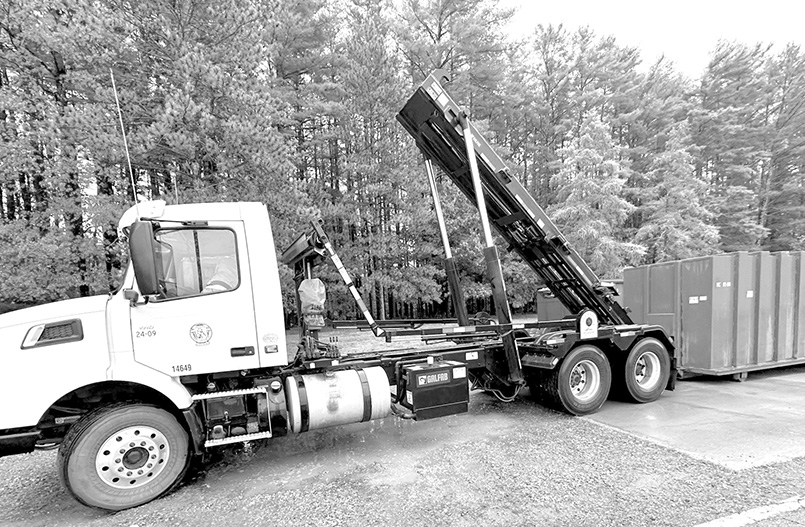
Warren County officials are weighing a change in how recyclable materials are handled — a change that, if adopted, could reduce taxpayer costs, generate new revenue and give municipalities greater control over commodities that currently leave the county through private waste processors.
The proposal, discussed July 22 by the Warren County Board of Supervisors’ Public Works Committee, reflects a broader change in the county’s thinking about recycling. Rather than viewing cardboard, paper, metals and plastics primarily as waste to be disposed of, county officials increasingly see them as marketable commodities whose value can be captured locally if municipalities control the collection and sale process.
“We’re proposing kind of local control,” Warren County Solid Waste and Recycling Compliance Coordinator Scott Royael told supervisors, arguing that every additional stop between a transfer station and the ultimate manufacturer adds transportation and processing costs that reduce the value of recyclable materials.
A business case for recycling
The concept under consideration is deliberately modest.
Rather than immediately constructing a large materials recovery facility, county officials are considering leasing a small building, purchasing or leasing a cardboard baler and beginning with one commodity: corrugated cardboard.
Cardboard was selected because it already is separated at municipal transfer stations and arrives relatively clean, avoiding much of the contamination that complicates single-stream recycling.
Based on current volumes, officials estimate Warren County municipalities collectively generate about 400 tons of recyclable cardboard annually. Instead of paying to have the material processed elsewhere, the county would bale it locally into tractor-trailer loads of roughly 40 to 44 bales before selling directly into commodity markets. At current volumes, officials estimate one outbound truckload per month.
The county estimates the approach could avoid approximately $87,000 annually in processing costs while also reducing fuel expenses and labor associated with hauling recyclables to existing processing facilities. Officials estimate a suitable building could be leased for roughly $25,000 annually, while a baler could either be purchased for about $30,000 or leased for about $5,000 per year.
Officials emphasized those figures are preliminary and would be refined before the county’s 2027 budget process.
Following North Elba’s example
The proposal is not without precedent.
County officials recently visited the Town of North Elba transfer station, where municipal employees have spent more than two decades separating, baling and marketing recyclables directly to recycling mills rather than relying exclusively on private material recovery facilities. Warren County officials described North Elba’s operation as evidence that even a rural Adirondack community can successfully market recyclables despite being distant from major transportation corridors.
That experience has become one of the principal models informing Warren County’s planning.
Instead of sending recyclable materials through commercial processing facilities that charge tipping and processing fees, North Elba’s system emphasizes maintaining cleaner, source-separated materials that command greater value in commodity markets.
The Warren County proposal similarly would rely on municipalities continuing to separate cardboard, plastics, metals, glass and paper at local transfer stations before shipping selected materials to a county aggregation facility.
Recycling as economic development
The initiative represents a broader evolution in recycling policy.
Historically, many local governments viewed recycling largely as an environmental mandate that carried significant operating costs.
Warren County officials are instead framing recycling as an economic activity that can simultaneously reduce disposal expenses and create revenue.
The county’s plan would eliminate fees paid to private material recovery facilities for selected materials while allowing municipalities to sell baled commodities directly to end users or brokers that supply manufacturers using recycled feedstock.
Officials said staffing could also be accomplished without creating many new positions by sharing existing transfer station employees through intermunicipal agreements. Part-time employees from municipal transfer stations could help operate the baling facility on days they are not working in their home communities, reducing labor costs while strengthening regional cooperation.
Bolton Supervisor Ron Conover, chairman of the Public Works Committee, endorsed the cautious approach.
“I like the approach. It’s walk before you run,” Conover said, arguing that beginning with a single baler allows the county to evaluate results before making larger investments.
State policy increasingly favors local recycling
The proposal also aligns with New York state’s growing emphasis on sustainable materials management.
The state Department of Environmental Conservation has increasingly encouraged communities to view discarded materials as resources rather than waste, promoting source separation, composting, waste reduction and development of local recycling infrastructure. DEC estimates that at least 80% of material currently disposed in landfills or waste-to-energy facilities still retains economic value. The agency also provides grants, technical assistance and regional recycling coordinators to help municipalities improve local recycling systems.
Royael told supervisors the proposed cardboard operation likely could qualify for reliable state assistance.
“We built this without putting in grant funding,” he said, “but there really are some match funding from the state that are pretty reliable.”
Separately, Warren County already has secured a $99,253 Climate Smart Communities grant from DEC to establish a composting pilot program capable of serving approximately 500 households, though officials are still awaiting execution of that grant agreement before construction can begin.
Part of a larger strategy
The recycling proposal is only one component of Warren County’s broader effort to reduce solid waste costs.
County Superintendent of Public Works Kevin Hajos noted that the county’s program of hauling waste and recyclables from municipal transfer stations, implemented about 18 months ago, has already produced significant savings for taxpayers. The county now hopes to build on those efficiencies by reducing processing costs and recovering more of the commodity value from recyclable materials.
If the proposal advances, county staff plan to finalize lease options, staffing plans, operating costs and business projections in time for budget discussions later this year, with a more complete business case ultimately supporting the 2027 budget process. For Warren County, the question is no longer simply how to recycle, but whether keeping ownership of recyclable materials from curbside to commodity market can turn what has traditionally been a disposal expense into a locally controlled economic asset.