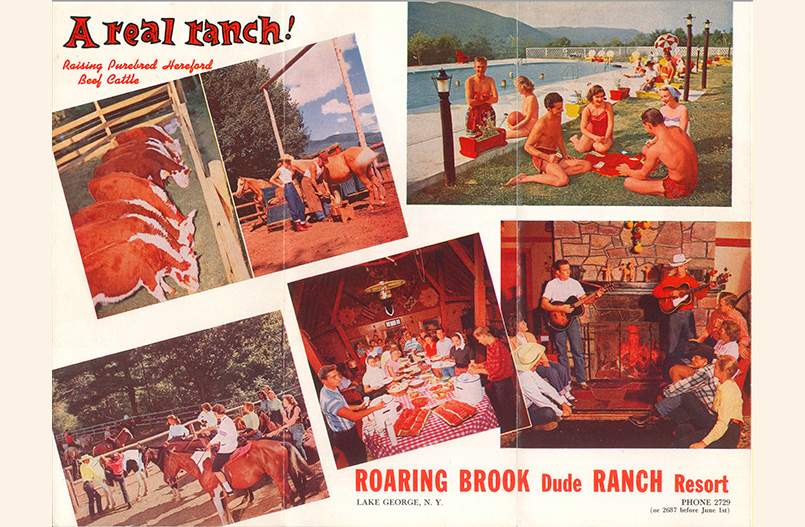
At the height of the craze for all things wild west, the Adirondack Park not only hosted theme parks and roadside attractions like Frontier Town, Indian Village and Ghost Town but western-style dude ranches, all-inclusive resorts where newly mobile families and single working men and women could play at – and with – cowboys.
In the 1950s, there were five dude ranches just on the road between Lake George and Lake Luzerne, not to mention a rodeo and at least ten western-themed bars.
In Warrensburg, “the romance of the wild west lives on at Sun Canyon Ranch,” crowed its boosters.
Roaring Brook Branch, located just outside Lake George Village, outlived the craze for cowboys, but it remained true to its origins as an all-inclusive resort, Jeff Garry told an audience at the Bolton Museum in Bolton Landing on July 9.
Garry’s grandfather, Joseph Garry, Sr, began buying the 19th century farms that would become the resort in 1939, opening it to the public after World War II.
“This area became very well known for its dude ranches and we rode that wave until the 1960s,” said Garry, who chronicled the ways in which the resort adapted to changing tastes and changing times, accommodating skiers, tennis players and ultimately conferences and groups like Americade. But for an agreement between New York State and the Haudenosaunee, it might have become a resort casino, like Turning Stone.
No different from Earl Woodward, the schoolteacher from Ohio credited with introducing dude ranches to the Adirondacks, or Art Bensen, the telephone company employee from Staten Island who created Frontier Town, Joseph Garry probably cared not a whit about the wild west. Like Woodward and Bensen, he was an entrepreneur. Land in the Adirondacks was cheap, the region was easily accessible from the cities, and tourists, whose imaginations had been fed by movies and radio, craved a western experience. Garry, no doubt, saw an opportunity, and he created an experience that tourists wanted.
According to Jeff Garry, the resort’s cowboys were the real thing.
“They would come east from Montana for the summer, work and board with us and ride the rodeo circuit,” he said.
The resort had a 50-horse stable and offered six, hour-long trail rides per day, as well as water skiing on Lake George, outdoor barbecues, volleyball and, of course, several meals a day.
The guests not only wanted to be fed and kept busy with activities; they wanted to be entertained.
“A house band played every night. We had a live ammunition show, a magician who billed himself as ‘the world’s seventh greatest magician.’ There was always something. Every night was great,” said Garry.
Jeff Garry’s talk complemented and supplemented the Bolton Museum’s current exhibit, “Welcome to Lake George: Vacation Paradise of the 50s and 60s.” So, too, do other talks in its “Thursday Nights at the Museum” lecture series, such as those chronicling water ski shows, one-design sailing races and the transformation of Bolton Landing after World War II. For information, visit theboltonmuseum.org.